
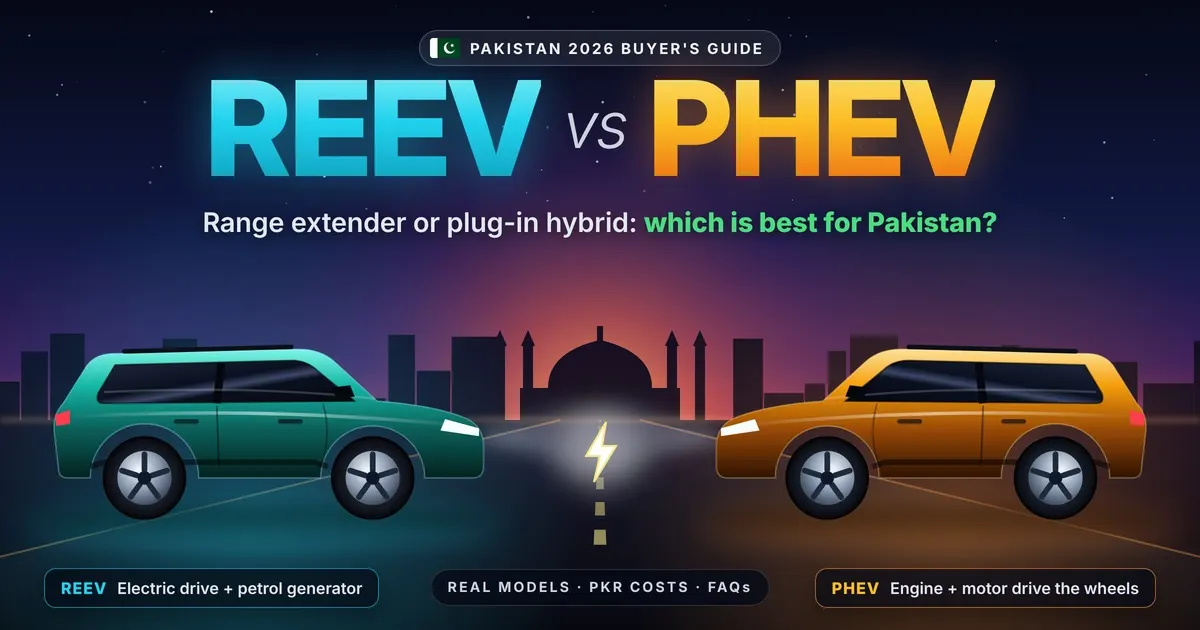
REEV vs PHEV: the quick answer
For most Pakistani drivers who can charge at home, a REEV is the better choice. A PHEV is better if you drive long motorway distances often, tow, or want a locally assembled car with an established dealer network. Both plug in, both carry a petrol engine, and both cut fuel bills sharply at today’s petrol prices. The difference is what that engine is allowed to do.
In a REEV (range-extended electric vehicle, also called EREV), the wheels are always driven by electric motors. The petrol engine is only a generator that tops up the battery. In a PHEV (plug-in hybrid electric vehicle), the petrol engine and the electric motor can both turn the wheels, together or on their own.
That single design choice changes battery size, electric range, how the car feels, what it costs to run and what can go wrong. Below, we compare the two using real models on sale in Pakistan in 2026, including the XPeng L03 REEV, Arcfox T5 REEV, Haval H6 PHEV, Jaecoo J7 PHEV and BYD Shark 6, with running costs worked out in rupees.
What is a REEV (range-extended electric vehicle)?
A REEV is an electric car with a small petrol generator on board. Electric motors always drive the wheels. When the battery runs low, the engine starts and makes electricity; it never connects to the wheels.
Because the car is designed to drive like an EV, REEVs carry bigger batteries and longer electric ranges than most PHEVs. Owners who charge at home rarely hear the engine on daily city trips.
How a REEV works
- You charge the battery at home or at a public charger.
- The car drives on battery power, exactly like an EV.
- When charge drops to a set level, the petrol engine starts and runs as a generator.
- The generator feeds the battery and motors, so you keep driving as long as there is fuel.
REEV cars in Pakistan (2026)
| Model | Price (PKR, ex-factory) | Battery | Electric range | Total range |
|---|---|---|---|---|
| XPeng L03 REEV | 11,500,000 | 37.2 kWh | 240 km (WLTP) | 1,100 km (WLTP) |
| Arcfox T5 REEV | 10,195,000 (Apex: 10,495,000) | 27.4 kWh | 193 km (NEDC) | 1,060 km |
| Forthing Friday REEV | 10,999,000 (pre-launch) | 31.9 kWh | Not confirmed | about 1,150 km |
| Changan Nevo Hunter REEV (pickup) | 10,990,000 | Not published | Not published | Not published |
- XPeng L03 REEV: the newest arrival, launched on 12 October 2026 with a 1.5-litre generator. Its standout feature is fast charging: up to 123 kW DC, or 10–80% in about 15 minutes. Deliveries are expected around November.
- Arcfox T5 REEV: brought in by Sazgar, with 268 hp and 365 Nm. Delivery is quoted at 3–4 months after booking.
- Forthing Friday REEV: a family SUV sold through Capital Smart Motors, also offered as a full EV.
- Changan Nevo Hunter REEV: Pakistan’s range-extender pickup. Bookings opened in August 2026, with first deliveries from October 2026.
Internationally, the Mazda MX-30 R-EV shows the idea in its purest form: a small rotary engine works only as a generator for a 17.8 kWh battery. In China, REEVs grew from zero in 2019 to over 12% of EV sales in early 2026 (Benchmark Minerals), and Pakistan’s new models come from that same wave.
REEV pros and cons
| Pros | Cons |
|---|---|
| Drives like a full EV: instant torque, silent, no gear changes | Less efficient than a PHEV on long motorway runs once the battery is empty |
| Bigger battery: about 190–240 km of electric range on Pakistani models | Heavier and dearer battery than a typical PHEV |
| Petrol backup removes range anxiety between cities | Mostly new brands in Pakistan, so dealer and parts networks are still growing |
| Simpler mechanicals: no multi-speed gearbox, engine runs at steady load | Engine can go weeks unused; it still needs oil, coolant and fresh fuel |
What is a PHEV (plug-in hybrid electric vehicle)?
A PHEV is a petrol car with a rechargeable battery and an electric motor added. Both the engine and the motor can drive the wheels, alone or together. You plug it in and drive short trips on electricity, then the engine takes over like a normal car.
Most PHEVs carry smaller batteries than REEVs, because the engine is expected to do the heavy lifting on long trips. In Pakistan, most PHEVs offer 80–90 km of electric range, which covers a typical day of city driving.
How a PHEV works
- You charge the battery at home or at a public charger.
- The car drives on electricity at low and medium speeds until the battery is spent.
- The petrol engine starts and drives the wheels through a gearbox, with the motor assisting.
- Under hard acceleration, both work together for maximum power.
PHEV cars in Pakistan (2026)
| Model | Price (PKR, ex-factory) | Battery | Electric range | Assembly |
|---|---|---|---|---|
| Jaecoo J7 PHEV | 10,499,000 | 18.3 kWh | ~90 km (WLTP) | Local, Nishat Motors (Faisalabad) |
| Haval H6 PHEV | 12,895,000 | Not stated | ~85 km | Local, Sazgar |
| Chery Tiggo 9 PHEV | 13,694,000 | 34.46 kWh | ~145 km | Not stated |
| Chery Tiggo 7 PHEV | 9,499,000 | Not stated | ~90 km | Not stated |
| MG HS PHEV | 9,899,000 | Not stated | 50+ km | Not stated |
| BYD Shark 6 (pickup) | 19,950,000 | 29.58 kWh | ~85 km | Imported; local assembly planned |
| GWM Tank 500 PHEV | 22,500,000 | Not stated | 87 km | Local, Sazgar |
- Jaecoo J7 PHEV: the value pick. A 1.5-litre turbo engine and dedicated hybrid transmission make 342 hp and 525 Nm, and it is built locally.
- Haval H6 PHEV: locally assembled by Sazgar, with an established Haval dealer network.
- BYD Shark 6: Pakistan’s plug-in hybrid pickup, aimed at buyers who would otherwise choose a Hilux or Revo.
- International benchmarks: the Range Rover P550e (38.2 kWh, up to 121 km WLTP) and BMW X5 xDrive50e (25.7 kWh usable) show where luxury PHEVs sit today.
PHEV pros and cons
| Pros | Cons |
|---|---|
| Engine drives the wheels directly, so it is efficient at steady motorway speeds | Electric range usually shorter than a REEV of the same price |
| Strong towing and sustained high-speed performance | Two complete drivetrains: engine, gearbox, motor and battery |
| Several locally assembled models with wider service networks | Feels like a petrol car once the battery is empty |
| Smaller, cheaper battery | Owners who never charge get poor fuel economy from a heavy car |
REEV vs PHEV: side-by-side comparison
The core difference is who drives the wheels. Everything else in the table follows from it.
| Feature | REEV (range extender) | PHEV (plug-in hybrid) |
|---|---|---|
| What drives the wheels | Electric motors only | Petrol engine, electric motor, or both |
| Role of the petrol engine | Generator only | Main power source on long trips |
| Battery (Pakistani models) | 27–37 kWh | 18–35 kWh |
| Electric range (Pakistani models) | 190–240 km | 50–145 km, mostly 85–90 km |
| Total range | 1,050–1,150 km | Similar to a petrol car of the same size |
| Gearbox | Single-speed reduction | Multi-speed automatic or dedicated hybrid transmission |
| Driving feel | Like an EV at all times | Like an EV until the battery empties, then like a petrol car |
| Motorway efficiency, battery empty | Lower (energy converted twice) | Higher (engine drives wheels directly) |
| Towing and sustained high speed | Good, but generator can lag on long climbs | Usually stronger |
| Mechanical complexity | Lower | Higher |
| Price band in Pakistan | Rs 1.02–1.15 crore | Rs 0.95–2.25 crore |
| Example models | XPeng L03, Arcfox T5, Forthing Friday, Changan Nevo Hunter | Jaecoo J7, Haval H6, Chery Tiggo 9, BYD Shark 6 |
Ranges are manufacturer figures on different test cycles (WLTP or NEDC; NEDC is the more optimistic). Real-world range in Pakistani summers is lower; see the next section.
Running costs, charging and maintenance in Pakistan
With petrol near Rs 394 a litre, every kilometre on home electricity saves about Rs 27. The REEV wins on cost because its bigger battery keeps you on cheap electricity for more of your driving.
Cost per 100 km (October 2026 prices)
| Energy source | Price | Cost per 100 km |
|---|---|---|
| Home charging, off-peak (three-phase meter) | Rs 23.57 per unit | Rs 424 |
| Public charging at the NEV-policy cap | Rs 39.70 per unit | Rs 715 |
| Independent fast chargers | Rs 110–150 per unit | Rs 1,980–2,700 |
| Petrol | Rs 393.86 per litre | Rs 3,151 |
On a 40 km daily commute, 26 days a month, home charging instead of petrol saves roughly Rs 28,000 a month. Two catches: the Rs 23.57 off-peak rate generally needs a three-phase connection, which most homes lack (an upgrade can cost Rs 30,000–65,000), and independent fast chargers wipe out most of the saving.
Load-shedding, solar and charging gaps
Pakistan’s charging network is concentrated in Karachi, Lahore and Islamabad, with real gaps between cities. That is exactly why REEVs and PHEVs suit Pakistan better than pure EVs for many buyers:
- Load-shedding: plan charging around your feeder’s outage schedule. If the power is off all night, the petrol engine still gets you to work; a pure EV would not.
- Rooftop solar: charging during daylight from your own panels is the cheapest energy of all, and a REEV’s large battery can soak up more of it.
- Intercity trips: with a REEV or PHEV you can drive Lahore–Islamabad or Karachi–Hyderabad without hunting for a charger.
Summer heat and real-world range
Air-conditioning, high motorway speeds and 45°C summers cut real-world electric range by roughly 15–25%. That hurts a PHEV more:
- A PHEV rated at 90 km (Jaecoo J7) may manage about 70 km in June. That still covers most city commutes, but with little spare.
- A REEV rated at 240 km (XPeng L03) still leaves around 180 km, so many owners go days without the engine starting.
Ask the dealer how the battery is cooled. Active liquid cooling copes far better with Pakistani summers than passive air cooling.
Motorway efficiency once the battery is empty
This is where a PHEV earns its place. A REEV converts petrol to electricity and then to motion, losing energy at each step. A PHEV’s engine drives the wheels directly at cruising speed, so on a long M-2 or M-9 run with an empty battery it generally burns less fuel.
Maintenance and parts
- PHEV: two full drivetrains to service: engine, gearbox with integrated motor, high-voltage battery and its cooling circuit. The upside in Pakistan is support: the Jaecoo J7, Haval H6 and Tank 500 are locally assembled, with established dealer networks.
- REEV: fewer moving parts. The engine runs at steady, efficient speeds and there is no multi-speed gearbox, which reduces wear. The catch is that XPeng, Arcfox and Forthing are new to Pakistan, so check the parts and service network in your city before buying.
- Both: regenerative braking extends brake pad life, the engine still needs oil and coolant even if it rarely runs, and keeping the battery cooling system healthy is the single most important job in Pakistani heat and dust.
REEV or PHEV: which is best in Pakistan, and why?
For most city drivers in Pakistan who can charge at home, a REEV is the better buy. At a similar price to a PHEV, it gives you two to three times the electric range, an EV’s smoothness every day, a petrol backup for load-shedding and intercity trips, and fewer parts to wear out.
A PHEV is the better buy if your driving or your priorities point that way. It suits frequent motorway trips on an empty battery, towing and rough-road use, and buyers who want a locally assembled car with an established dealer network today.
| Choose a REEV if you… | Choose a PHEV if you… |
|---|---|
| Can charge at home (ideally three-phase or solar) most days | Drive the M-2, M-9 or GT Road often, well beyond your battery range |
| Mostly drive within Karachi, Lahore, Islamabad or Rawalpindi | Tow, carry heavy loads or drive rough roads in the north |
| Want an EV feel without range anxiety | Want a locally assembled car with wide parts support |
| Want lower long-term mechanical wear | Prefer an established brand network in smaller cities |
| Are comfortable with newer brands such as XPeng, Arcfox or Forthing | Want stronger resale confidence in the used market today |
Real-world matchups
- Lahore or Karachi office commute, 40–60 km a day: the XPeng L03 REEV covers three to four days on one charge, even in summer. A Jaecoo J7 PHEV covers about one day before the engine takes over.
- Regular Islamabad–Lahore motorway driver: a Haval H6 PHEV or Jaecoo J7 PHEV. Its engine drives the wheels efficiently at 120 km/h once the battery is empty.
- Around Rs 1 crore budget: the Arcfox T5 REEV (Rs 1.02 crore) offers roughly twice the electric range of the Jaecoo J7 PHEV (Rs 1.05 crore). The Jaecoo counters with local assembly and 342 hp.
- Pickup for work, farms or the north: the BYD Shark 6 PHEV is the proven option; the Changan Nevo Hunter REEV is the newer range-extender alternative.
- If you cannot charge at home: neither is ideal. A self-charging hybrid may cost less overall.
Frequently asked questions
What is the main difference between a REEV and a PHEV?
In a REEV, only electric motors drive the wheels and the petrol engine acts as a generator. In a PHEV, the petrol engine and the electric motor can both drive the wheels.
Is a REEV better than a PHEV in Pakistan?
For drivers who charge at home and mostly drive in cities, yes. A REEV offers two to three times the electric range at a similar price. A PHEV is better for frequent motorway trips, towing and buyers who want a locally assembled car.
Is EREV the same as REEV?
Yes. EREV (extended-range electric vehicle), REEV (range-extended electric vehicle), REV and REx all describe the same layout: electric drive with a petrol generator.
Which REEV cars are available in Pakistan?
In 2026 you can buy or book the XPeng L03 REEV, Arcfox T5 REEV, Forthing Friday REEV and the Changan Nevo Hunter REEV pickup.
Which PHEV cars are available in Pakistan?
The Jaecoo J7, Haval H6, Chery Tiggo 7, 8 and 9, MG HS, GWM Tank 500 and BYD Shark 6 are all sold as plug-in hybrids. The Jaecoo J7, Haval H6 and Tank 500 are locally assembled.
How much does it cost to charge a REEV or PHEV at home in Pakistan?
On the off-peak rate of about Rs 23.57 per unit, roughly Rs 4 to 5 per km, against about Rs 31 per km on petrol. The off-peak rate usually needs a three-phase meter.
Can I drive a REEV or PHEV during load-shedding?
Yes. If you could not charge, the petrol engine keeps the car running. That is a key advantage over a pure electric car in Pakistan.
Can you drive a REEV without charging it?
Yes. The petrol generator keeps the car moving as long as there is fuel. But fuel economy is worse than running on charge, so you lose most of the saving if you never plug in.
Which is more fuel-efficient on the motorway?
A PHEV, once the battery is empty. Its engine drives the wheels directly at cruising speed, while a REEV converts petrol into electricity first and loses some energy along the way.
Does Pakistan’s summer heat reduce electric range?
Yes. Expect roughly 15–25% less electric range in 45°C heat with the air-conditioning on. A longer-range REEV absorbs that loss more easily than a short-range PHEV.
Do PHEVs and REEVs need regular servicing?
Yes. Both have a petrol engine that needs oil, filters and coolant, plus a high-voltage battery and cooling system to check. PHEVs also have a gearbox to maintain, so they usually have more service items.
Conclusion
REEVs and PHEVs both plug in and both carry petrol, but they solve different problems. A REEV is an electric car that never strands you; a PHEV is a petrol car that can run on electricity for short trips.
If you charge at home and spend most of your time in Pakistan’s big cities, a REEV such as the XPeng L03 or Arcfox T5 gives you the most electric driving for your rupee, with petrol as insurance against load-shedding and long trips. If you live on the motorway, tow, or want a locally assembled car with a proven dealer network, a PHEV such as the Jaecoo J7 or Haval H6 remains the smarter pick.
Whichever you choose, keep it charged, keep the battery cooling healthy through the summer, and service the engine on schedule even if it rarely runs.


